
Diabetes Prevention Program (DPP) Support
Healthie offers providers that deliver the CDC's National Diabetes Prevention Program (DPP) Lifestyle Change Program (LCP) several resources to help with facilitation and delivery.
Note: If you are still using the 2021 version of the DPP charting from, email hello@gethealthie.com and we'll add the most recent DPP form to your account.
IN THIS ARTICLE:
How Healthie supports DPP
Here is an overview of what we offer:
1. Diabetes Prevention Programs Modules: Healthie has built out the CDC's default program, in English & Spanish, for your utilization in Programs. While many organizations elect to customize the module / lesson experience, the CDC's initial templates can serve as a great starting point for your program delivery. Please e-mail hello@gethealthie.com if you’d like these added to your account.
2. Diabetes Prevention Program Report: Healthie's Smart Form for Diabetes Prevention Program makes it easy for you to aggregate and submit required information to the CDC for the purposes of tracking participant engagement and outcomes, as well as collecting reimbursement based on program delivery.
- If the DPP Charting Template has been added to your account, you will see a charting template called "DPP Sessions." When you complete this template within your client’s Chart Note, the answers will populate into your DPP Report.
3. Handouts and Resources: the Guide to Diabetes Prevention Program is available to help you learn about DPP, and why organizations use Healthie to deliver DPP
Note: These resources are available on the Healthie Plus Plan or above. If you are interested in accessing these, please e-mail hello@gethealthie.com.
DPP Report
If you are interested in accessing this report, please e-mail us at hello@gethealthie.com.
You will be given a specific charting template to complete, and answers generated in that Charting Template will populate into your DPP report.
Generate Your DPP Report
Once you've been using the DPP charting template for your DPP clients, you are able to generate a DPP report that will aggregate your data in a CSV file. The report is generated in a special formate that the CDC uses, making it simple to report your data to the CDC.
To generate the report:
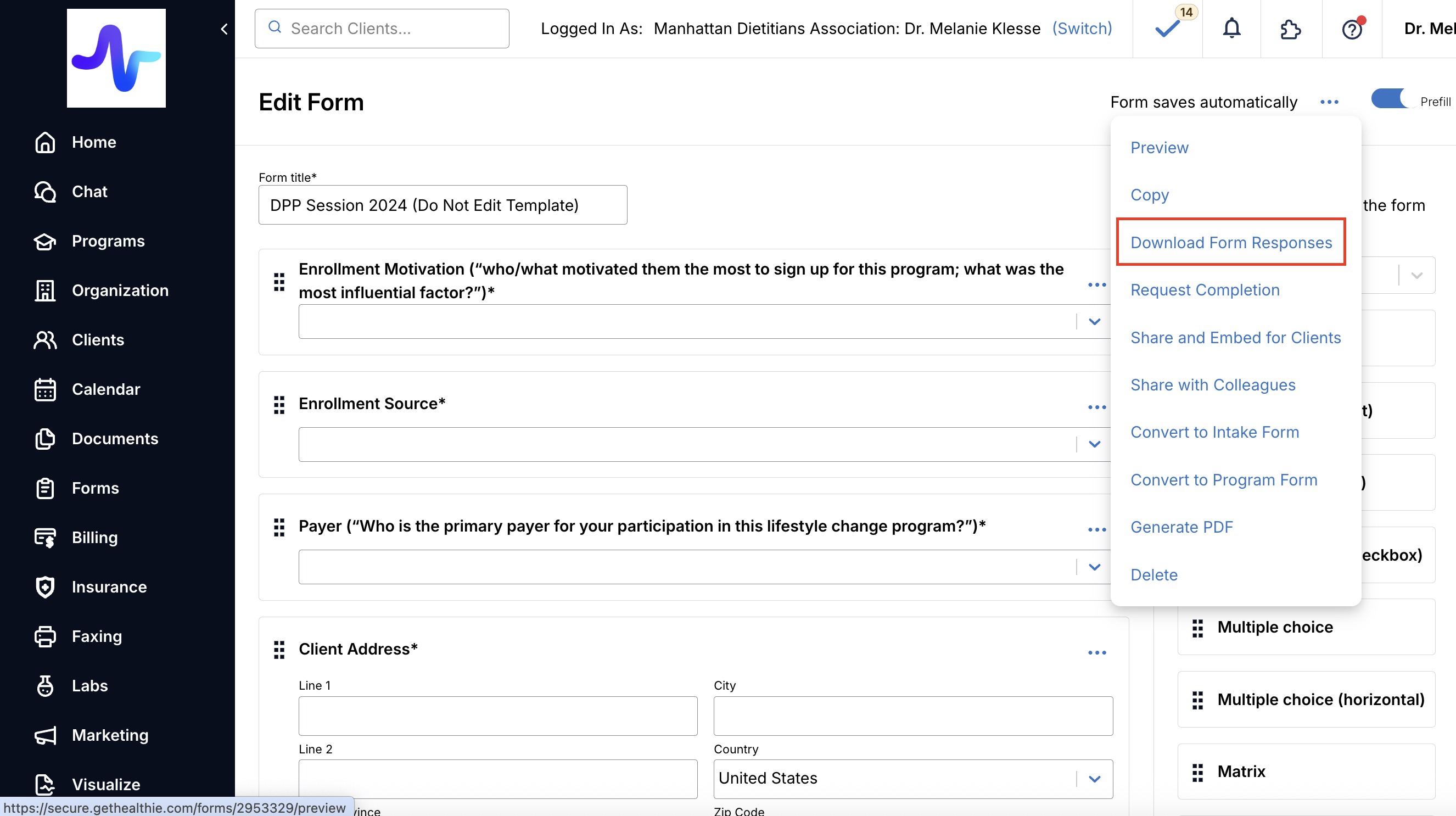
- Navigate to Forms > Search for DPP > locate DPP Session 2024 (Do Not Edit Template)
- Select [...] for the DPP form > Edit
- Select [...] on the top right > Download Form Responses
Access your CSV file by navigating to Documents > Generated Reports folder. This may take up to 30 minutes to complete, you can navigate away from forms and use the platform as usual.
Columns in the Healthie DPP Report
The Diabetes Prevention Program Report Template is based on the recommended columns by CDC for tracking participation and outcomes.
These columns currently include:
- ORGCODE: Provided by CDC *If you would like this code to automatically populate into your report, please email us at hello@gethealthie.com with your code.
- PARTICIP: Participant ID is uniquely assigned and maintained by the applicant organization and must not contain any PII. Up to 25 alphanumeric characters *If using only numbers, please limit to 10 to avoid formatting issues. CDC suggests not using IDs resembling dates.
- COHORTID: Cohort ID is uniquely assigned and maintained by the applicant organization and must not contain any PII. Up to 25 alphanumeric characters. *If using only numbers, please limit to 10 to avoid formatting issues. CDC suggests not using IDs resembling dates.
- COACHID: Coach ID is uniquely assigned and maintained by the applicant organization and must not contain any PII. *If using only numbers, please limit to 10 to avoid formatting issues. CDC suggests not using IDs resembling dates. Lifestyle Coaches who deliver the Medicare DPP should use their NPI as their Coach ID.
- ENROLLMOT: At enrollment, participants are asked who/what motivated them the most to sign up for this program.
- Possible Values:
- (1) Health care professional
- (2) Blood test results
- (3) Prediabetes Risk Test (short survey)
- (4) Someone at community-based org (e.g. church, fitness center)
- (5) Family or friends
- (6) Current or past participant in the National DPP LCP
- (7) Employer or employer's wellness plan
- (8) Health insurance plan
- (9) Media advertisements (e.g. social media, flyer, radio ad)
- (10) Program Champion
- Possible Values:
- ENROLLHC: At enrollment, participants are asked if a health care professional asked them to join the National DPP LCP.
- Possible Values:
- (1) Yes, a doctor/doctor's office
- (2) Yes, a pharmacist
- (3) Yes, other health care professional
- (4) No
- Possible Values:
- PAYERSOURCE: At enrollment, participants are asked “Who is the primary payer for your participation in the National DPP LCP?”
- Possible Values:
- (1) Medicare
- (2) Medicaid
- (3) Private/commercial insurer
- (4) Self-pay
- (5) Dual Eligible (Medicare and Medicaid)
- (6) Grant funding
- (7) Employer
- (8) Free of charge
- (10) Government/Military
- (11) Venture capital
- Possible Values:
- STATE: Two-letter abbreviation for the U.S. state or territory in which the participant resides.
- PARTICIPZIP: 5-digit zip code for the locality where the participant resides
- AGE: 18 to 125 (in years, rounded with no decimals)
- AIAN: If race is not reported by the participant, all of the 7 race variables will be coded as ‘2’
- Possible Values:
- (1) American Indian or Alaska Native
- (2) NOT American Indian or Alaska Native (default)
- Possible Values:
- ASIAN: If the race is not reported by the participant, all of the 7 race variables will be coded as ‘2’
- Possible Values:
- (1) Asian or Asian American
- (2) NOT Asian or Asian American(default)
- Possible Values:
- BLACK: If a race is not reported by the participant, all of the 7 race variables will be coded as ‘2'
- Possible Values:
- (1) Black or African American
- (2) NOT Black or African American (default)
- Possible Values:
- HISPANIC: If a race is not reported by the participant, all of the 7 race variables will be coded as ‘2'
- Possible Values:
- (1) Hispanic or Latino
- (2) NOT Hispanic or Latino
- Possible Values:
- MENA: If a race is not reported by the participant, all of the 7 race variables will be coded as ‘2'
- Possible Values:
- (1) Middle Eastern or North African
- (2) NOT Middle Eastern or North African
- Possible Values:
- NHPI: If a race is not reported by the participant, all of the 7 race variables will be coded as ‘2’
- Possible Values:
- (1) Native Hawaiian or Other Pacific Islander
- (2) NOT Native Hawaiian or Other Pacific Islander
- Possible Values:
- WHITE: If race is not reported by the participant, all of the 7 race variables will be coded as ‘2’
- Possible Values:
- (1) White
- (2) NOT White
- Possible Values:
- ETHRACEINFO: Open text field for additional information on participant's ethnicity and race *May use up to 100 alphanumeric characters, including spaces. If not reported, the variable should be coded as NA.
- SEX:
- Possible Values:
- (1) Male
- (2) Female
- (3) Not reported
- Possible Values:
- HEIGHT: Participant's Height as a value from 30 to 98 (in inches)
- EDU:
- Possible Values:
- (1) Less than grade 12 (No high school diploma or GED)
- (2) Grade 12 or GED (High school graduate)
- (3) Some college or technical school
- (4) College or technical school graduate or higher
- (9) Not reported
- Possible Values:
- DIFFHEAR: This variable refers to the response to the first question in the six-item set of questions to assess disability status.
- Possible Values:
- (1) Deaf or has serious difficulty hearing
- (2) NOT deaf or DOES NOT serious difficulty hearing
- (9) Participant chose not to respond
- Possible Values:
- DIFFSEE: This variable refers to the response to the second question in the six-item set of questions to assess disability status.
- Possible Values:
- (1) Blind or has serious difficulty seeing, even when wearing glasses
- (2) NOT blind or DOES NOT serious difficulty seeing, even when wearing glasses
- (9) Participant chose not to respond
- Possible Values:
- DIFFMEM: This variable refers to the response to the third question in the six-item set of questions to assess disability status.
- Possible Values:
- (1) Has serious difficulty concentrating, remembering or making decisions because of a physical, mental or emotional condition
- (2) DOES NOT have serious difficulty concentrating, remembering or making decisions because of a physical, mental or emotional condition
- (9) Participant chose not to respond
- Possible Values:
- DIFFWALK: This variable refers to the response to the fourth question in the six-item set of questions to assess disability status.
- Possible Values:
- (1) Has serious difficulty walking or climbing stairs
- (2) DOES NOT have serious difficulty walking or climbing stairs
- (9) Participant chose not to respond
- Possible Values:
- DIFFDRESS: This variable refers to the response to the fifth question in the six-item set of questions to assess disability status.
- Possible Values:
- (1) Has difficulty dressing or bathing
- (2) DOES NOT have difficulty dressing or bathing
- (9) Participant chose not to respond
- Possible Values:
- DIFFERRAND: This variable refers to the response to the sixth question in the six-item set of questions to assess disability status.
- Possible Values:
- (1) Has difficulty doing errands alone because of a physical, mental or emotional condition.
- (2) DOES NOT have difficulty doing errands alone because of a physical, mental or emotional condition
- (9) Participant chose not to respond
- Possible Values:
- A1C: Required if organization plans to use the participant's A1C to determine reduction in risk.
- Possible Values:
- 5.7 to 6.4 for pre-intervention (initial entry)
- 2.5-18 for all other entries
- 999 if not reported
- Possible Values:
- GLUCTEST: Acceptable tests include FG, oral glucose tolerance test (OGTT), A1C, or a lab test result indicating diagnosis of prediabetes.
- Possible Values:
- (1) Prediabetes diagnosed by blood glucose test
- (2) Prediabetes NOT diagnosed by blood glucose test
- Possible Values:
- GDM:
- Possible Values:
- (1) Prediabetes determined by clinical diagnosis of GDM during a previous pregnancy
- (2) Prediabetes NOT determined by GDM (default)
- Possible Values:
- RISKTEST:
- Possible Values
- (1) Prediabetes determined by the ADA/CDC Prediabetes Risk Test
- (2) Prediabetes NOT determined by the ADA/CDC Prediabetes Risk Test (default)
- Possible Values
- DMODE:
- Possible Values:
- (1) In-person
- (2) Online
- (3) Distance learning
- Possible Values:
- SESSTYPE: Any session delivered in months 1-6, even if pulled from months 7-12 of the PreventT2 curriculum content, for example, must be coded as a Core session (C). Any session delivered in months 7-12, even if pulled from months 1-6 of curriculum content, must be coded as a Core Maintenance session (CM).
- Possible Values:
- C: Core session
- CM: Core maintenance session
- OM: Ongoing maintenance sessions
- MU-C: Make-up sessions in the Core phase
- MU-CM: Make-up sessions in the Core Maintenance phase
- MU-OM: Make-up sessions in the Ongoing Maintenance phase
- Possible Values:
- DATE: Each data record represents attendance by one participant at one session; must specify the actual date of the session. One make-up session per week may be recorded on the same session date as a regularly scheduled session. Date format should be: mm/dd/yyyy
- WEIGHT: At each session, participants are weighed; weight must be included on the record for that session and participant. Weight may be obtained by the Lifestyle Coach or participant on a regular scale or through the use of a digital or Bluetooth-enabled scale. For Medicare DPP suppliers, see CMS guidance.
- Possible Values:
- 70 to 997 (in pounds)
- 999 Not recorded (default)
- Possible Values:
- PA: At some or all program sessions, participants are asked to report the number of minutes of moderate or brisk physical activity they completed since the previous session attended. If a participant reports doing no activity since the previous session attended, or has not tracked their minutes, then zero (0) minutes should be recorded.
- Possible Values: 0 to no max (minutes)
Note: values for the first four columns of the DPP Report (ORGCODE, PARTICIP, COHORTID and COACHID) are sourced from organization, provider and client information, not from the DPP charting form.
ORGCODE can be set on by navigating to Settings > Insurance > Billing providers > [...] > Edit > ID Number type dropdown > Other ID > fill in Other ID field > Save changes.
Best Practices for DPP in Group Settings
Here’s how we recommend navigating documentation for DPP group sessions in Healthie. Clients can complete their individual session charting notes with minimal manual data entry by leveraging automated form requests and pre-fill functionality.
Step 1: Configure the DPP Form
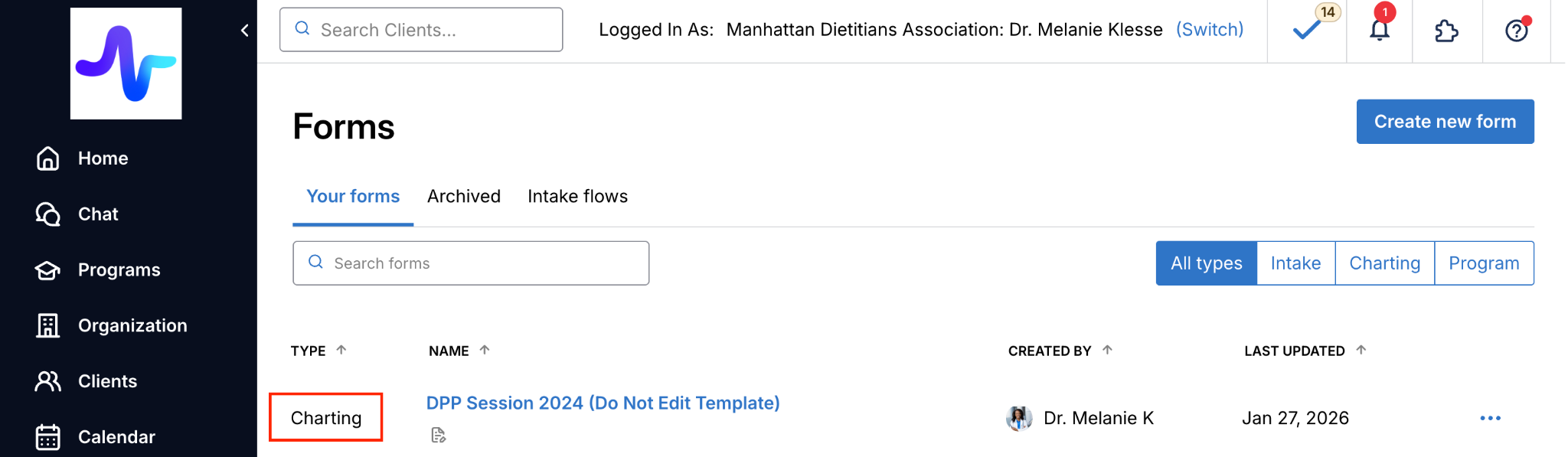
- Navigate to Forms > locate the DPP Session 2024 (Do Not Edit Template) form
- Verify the following settings:
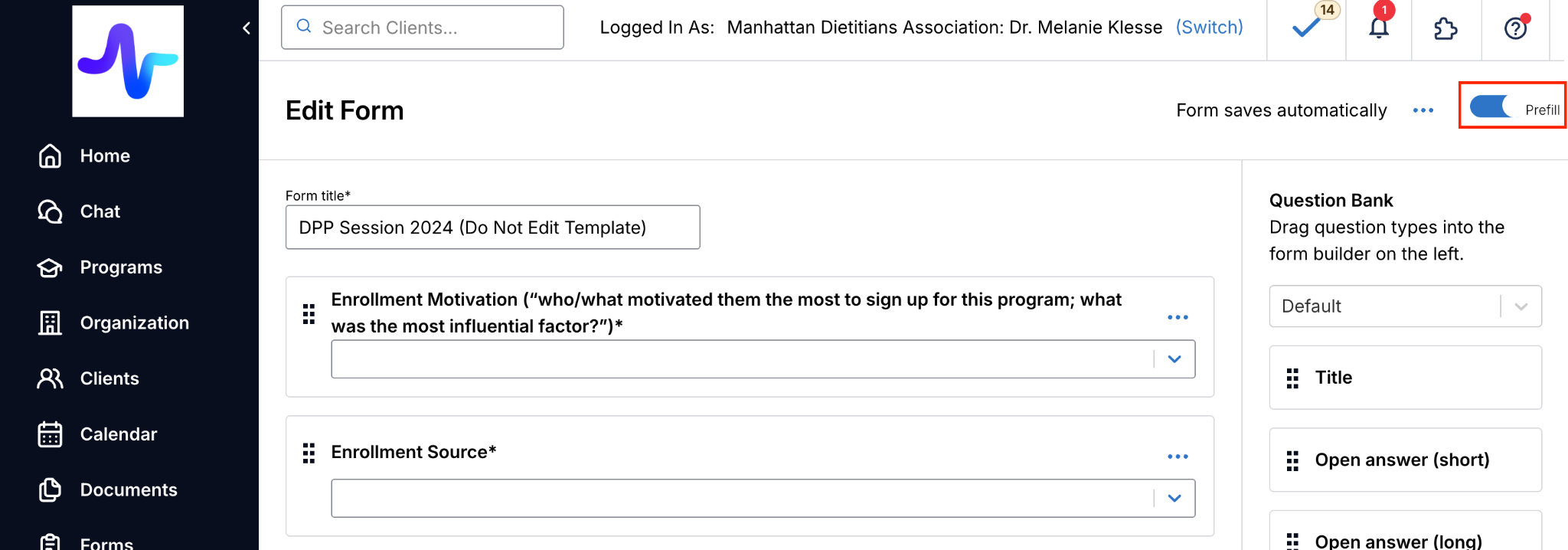
- Use for Charting is enabled
- Pre-fill is enabled (this allows subsequent sessions to auto-populate with previous responses)
Step 2: Create a Group Appointment Type
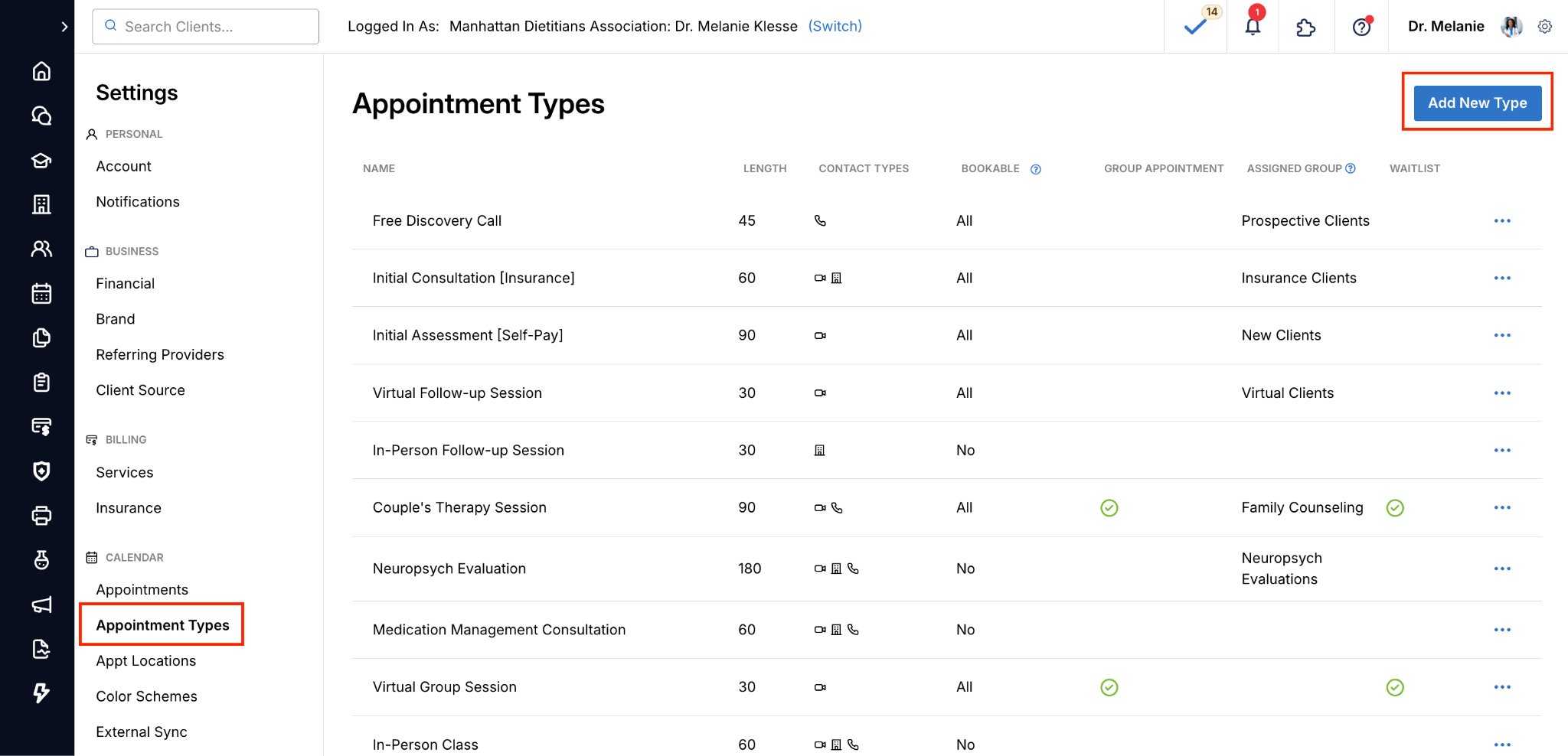
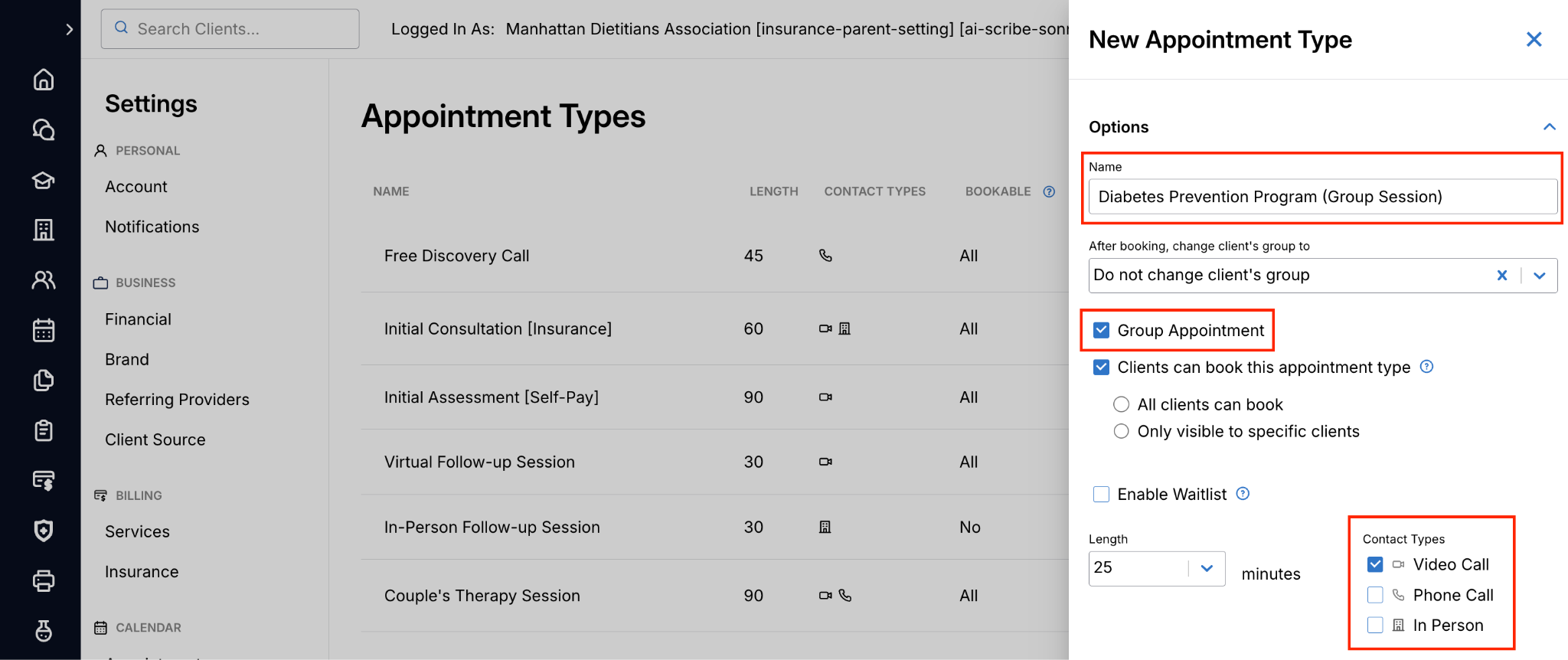
- From your Healthie Dashboard click on Settings > Appointment Types
- Select Add New Type and include the following:
- Name: Diabetes Prevention Program (Group Session)
- Group Appointment: Enabled
- Contact Type: Select your preferred delivery method (In-Person, Video Call, or Phone Call)
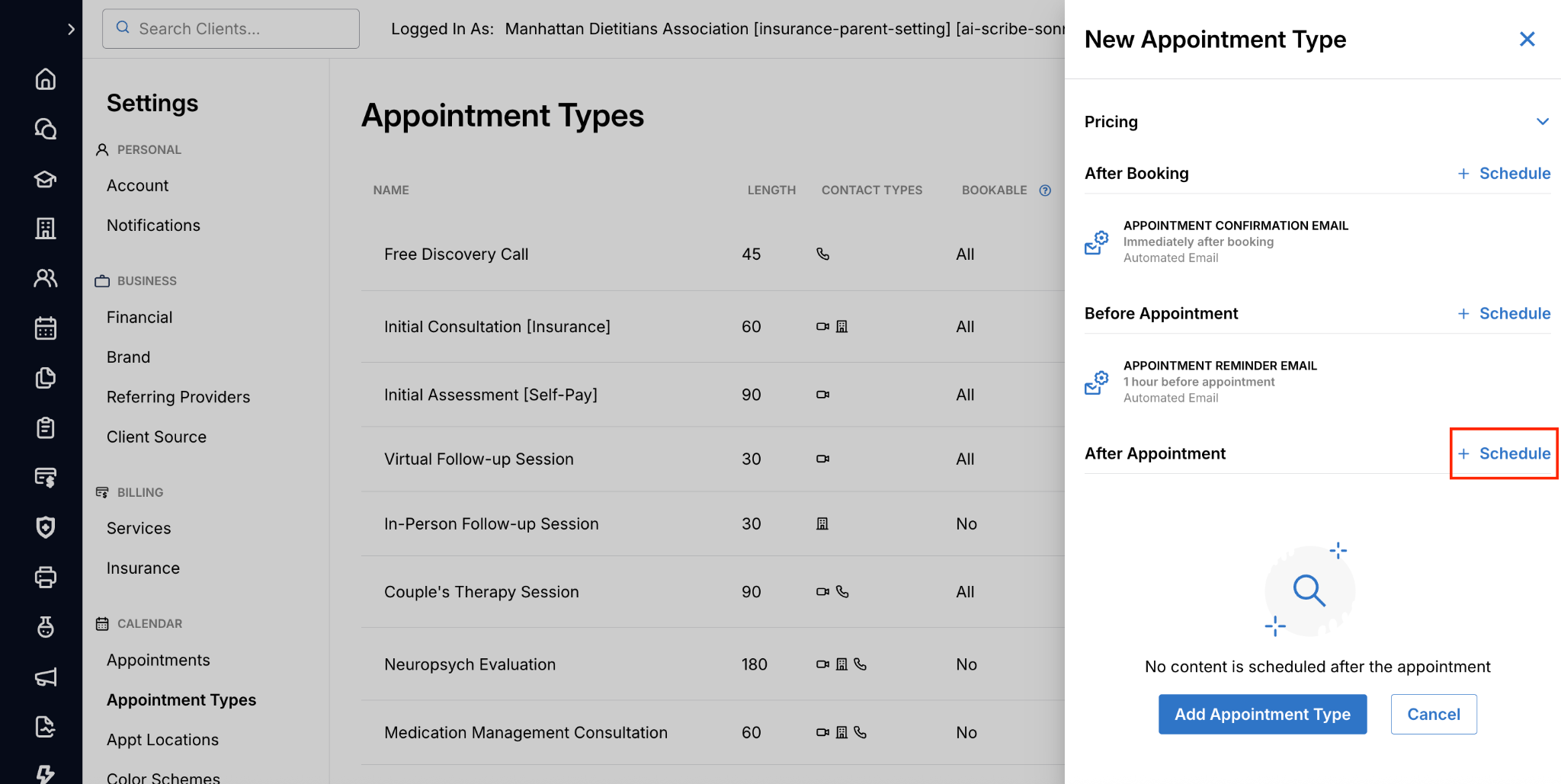
- In the After Appointment section:
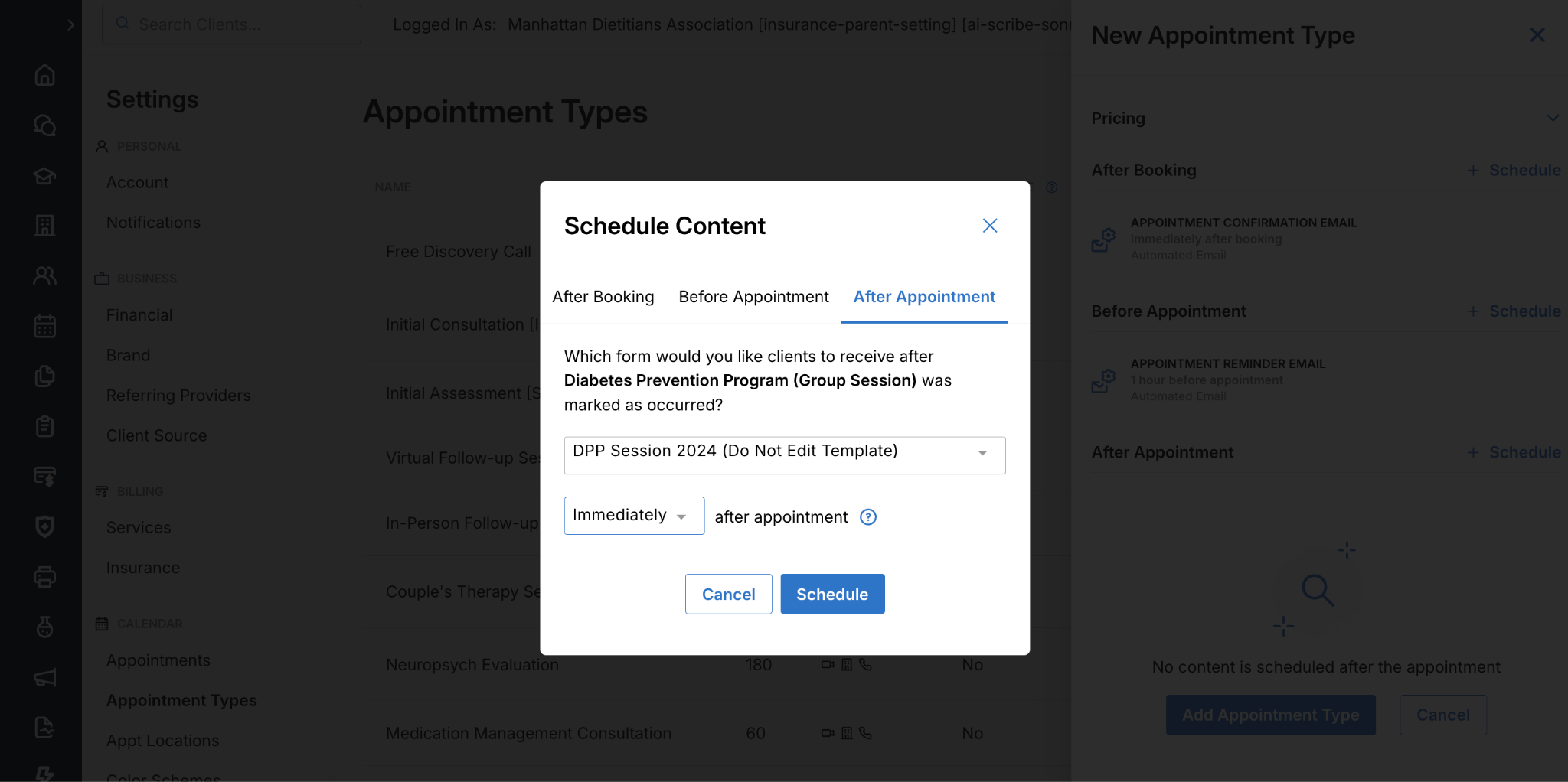
- Click + Schedule > Select DPP Session 2024 (Do Not Edit Template)
- Set the delivery timing
- Recommended: Immediately after appointment
- Alternative: 1 hour after appointment (or your preference
Note: sending the form immediately after the session ensures clients complete it while details are fresh, improving accuracy and completion rates.
Step 3: Document the Group Session
When creating the appointment charting note:
- Use a general/blank charting template for group-level session notes (do not use the DPP Session 2024 form for the group charting note itself)
- Document general session information such as:
- Topics covered
- Group dynamics
- General observations
- Next session plans
Note: the DPP form is designed for individual participant data collection, not group-level documentation.
Step 4: Mark Appointment as Complete
When the session ends:
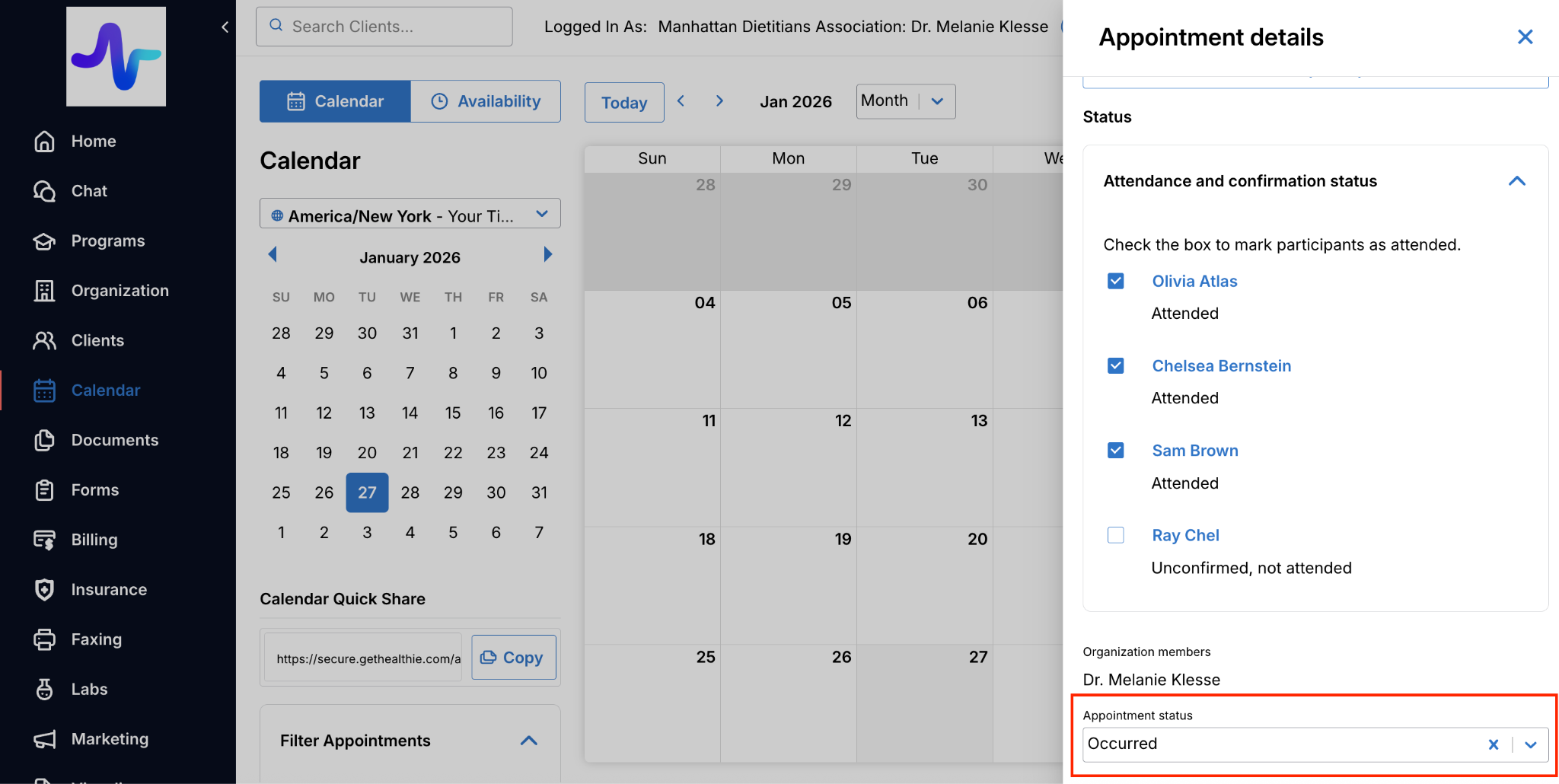
- Navigate to Calendar > click on the group session > mark the Appointment status as Occurred. This triggers the automated form request to all attendees.
- Each participant will receive a notification to complete their individual DPP Session form.
Step 5: Participants Complete Their Forms
After the appointment is marked as Occurred, each attendee will:
- Receive a form completion request via their preferred notification method
- Open the form to find pre-populated information including:
- Address
- Date of birth
- Gender
- Height
- Most recent weight (after first session)
- Demographic information already on file
- Complete the remaining required fields:
- Enrollment information (first session only)
- Session type (verbally communicated by instructor)
- Current session weight
- Physical activity minutes for the reporting period
Tip: Instructors should verbally announce the SESSION TYPE at the beginning or end of each session to ensure accurate form completion. The possible values are listed within the DPP Session 2024 charting form in Session Type Instructions.
Step 6: Streamlined Form Completion for Subsequent Sessions
For sessions 2 and beyond, the pre-fill feature significantly reduces manual data entry:
- Most fields auto-populate with information from the previous session
- Participants only need to update:
- Session date (pre-filled but should verify)
- Session type (if changed)
- Current weight
- Physical activity minutes
- Any demographic changes (address, phone, etc.)
- Updated health metrics (most recent A1C, if applicable)
This streamlined process typically takes participants 2-3 minutes, instead of 10-15 minutes for the initial form.
Step 7: Export Form Responses
You can access and export DPP session data by following the DPP Report instructions.
Tips to Optimize DPP in Group Settings
For Administrators:
- Send a brief guide to participants before their first DPP session explaining the form completion process
- Include screenshots showing how to access and complete the form
- Set up reminder notifications for incomplete forms (24-48 hours after session)
- Consider adding a client tag for users participating in your DPP or assigning them to a client group accordingly
For Providers:
- Always verbally announce the session type during each session
- Remind participants to complete their form before leaving (if using immediate delivery)
- Keep a reference sheet visible showing the session type codes
For Clients:
- Complete the form as soon as possible after a group session
- Double-check that session type matches what the instructor announced
- Update weight and activity minutes accurately
- Contact support at hello@gethealthie.com if any pre-filled information is incorrect
Leverage Healthie's API to Streamline DPP Group Sessions
Healthie's API enables powerful automation to reduce manual work and improve data accuracy for DPP group session documentation. Below are recommended integrations to enhance your workflow:
API Automation Recommendations
- Auto-Generate Forms for Attended Participants: When an appointment is marked "Occurred," automatically create individual DPP forms only for participants marked as "attended." Pre-populate demographic data (address, DOB, height, sex, ethnicity, race), session information (date, delivery mode), most recent weight, and calculated weekly physical activity minutes. Participants only verify/update data rather than completing the entire form.
- Smart Session Type Auto-Detection: Automatically determine session type based on participant's enrollment date and session count (Sessions 1-16 = Core, Sessions 17-25 = Core Maintenance, Post-month 12 = Ongoing Maintenance). Eliminates the most common data entry error.
- Automated Completion Reminders: Send automated SMS/email reminders to participants with incomplete forms 24-48 hours after sessions. Notify administrators of outstanding forms to improve completion rates from ~70% to ~95%.
- Real-Time Completion Dashboard: Build an admin interface showing form completion status for all recent DPP sessions, which participants have/haven't completed forms, and one-click bulk reminder sending for proactive monitoring.
- Automated Metric Pulling: Pull the most recent weight entry and calculate total physical activity minutes from Healthie entries or connected wearables (Apple Health, Fitbit, Google Fit). Flag outliers for manual review to reduce manual entry and improve accuracy.
- CDC-Compliant Reporting Automation: Automatically extract all required DPRP data elements, format according to CDC specifications, and generate CSV files for upload. Include data validation checks to eliminate hours of manual compilation and reduce reporting errors.
- Program Analytics Dashboard: Track participant progress with metrics including weight loss trajectories, average physical activity minutes, session attendance rates, goal achievement (≥5% weight loss + ≥150 min/week activity), and cohort comparisons for data-driven program improvements.
- Enrollment Data Pre-Population (First Session Only): Create initial form with one-time enrollment fields (motivation, source, payer, initial A1C/glucose test/risk test, complete demographics) and mark as read-only in subsequent sessions. Reduces first session form time from 15 minutes to 5 minutes.
Technical Requirements:
Webhooks for appointment.updated form_answer_group.created/updated completed_onboarding_item.created/updated ; API access to queries (appointment, user, entries, formAnswerGroups) and mutations (createFormAnswerGroup, updateFormAnswerGroup)
FAQs
Why is the most recent form named for 2024?
The form is named based on the CDC's 2024 requirements and updates, and reflects their 2024 compliance standards.
Will I lose data collected through the 2021 DPP Session Form?
No, we did not deprecate the 2021 DPP Session Form so you can still Download Form Responses for that version.